

AI Infrastructure index (AIII)
Tracking the companies building the infrastructure behind artificial intelligence.
Semiconductors • Networking • Data Centers • Power • Automation
Software • Cyber Security • Critical Minerals
What is AIII?
The AI Infrastructure Index (AIII) is a rules-based index designed to track the companies building the foundation of the AI economy.
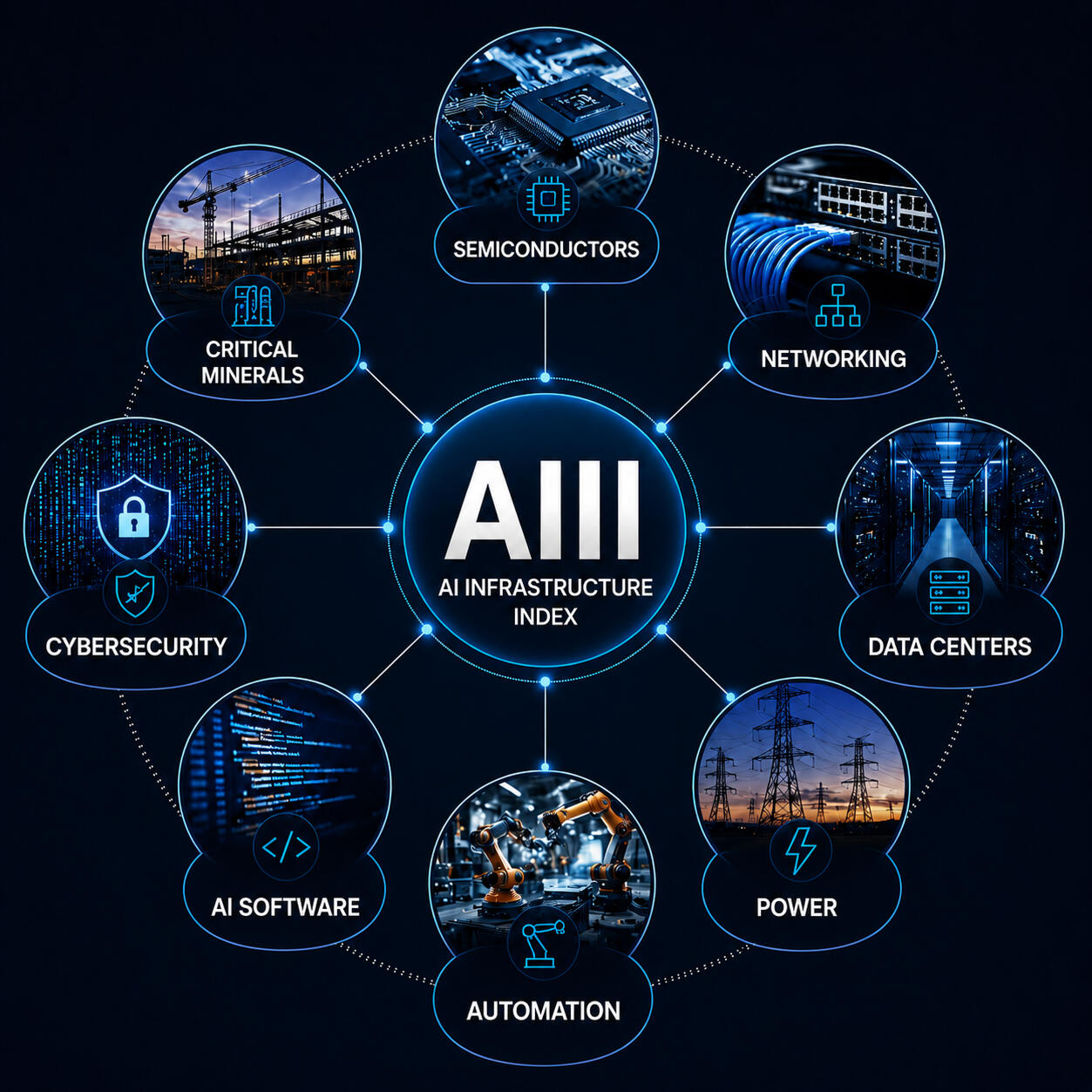
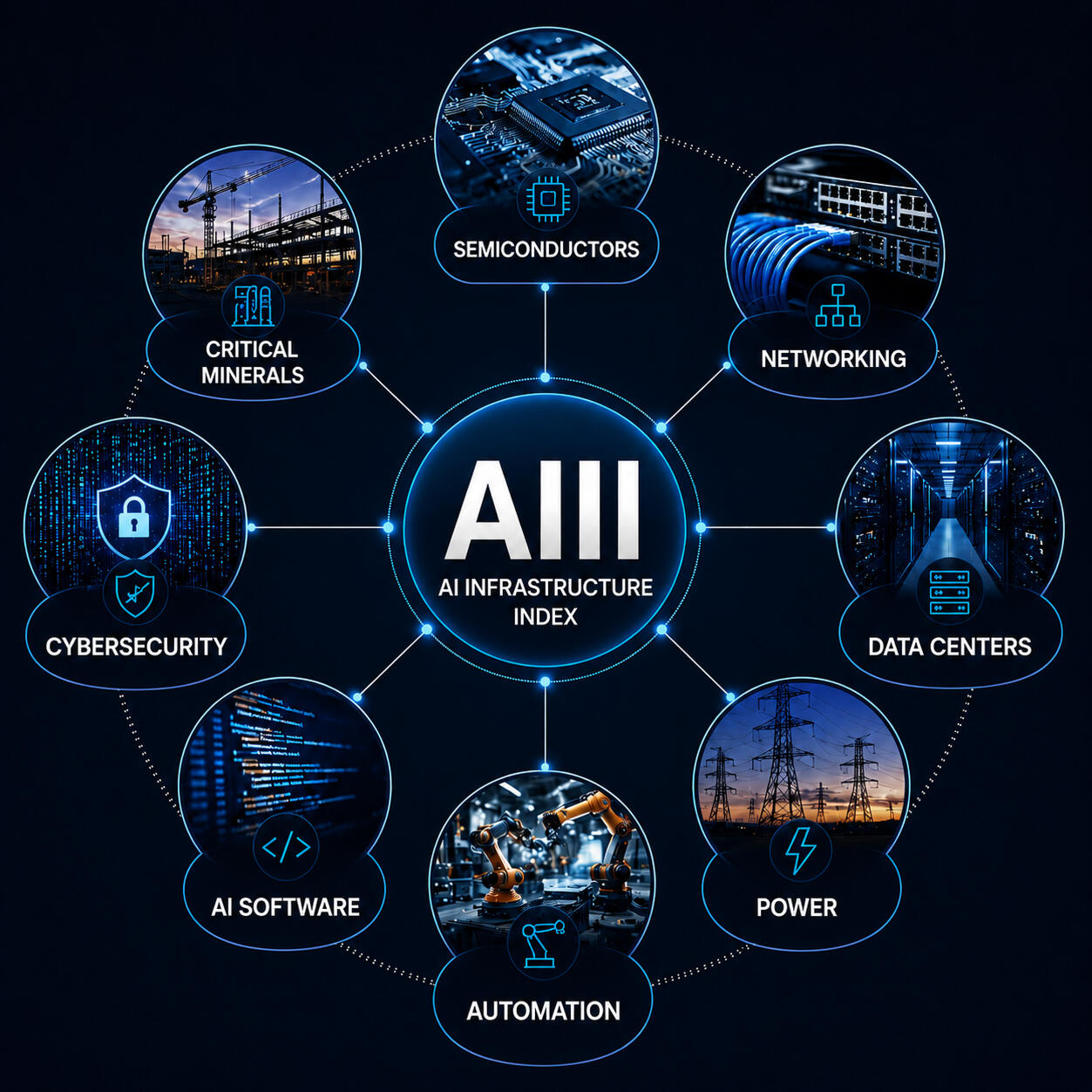
While most investors focus on semiconductors and AI applications, AIII focuses on the eight interconnected pillars that together form the foundation of the AI economy.
Why Infrastructure?
Our Thesis
Most investors focus on the companies using artificial intelligence.AIII focuses on the companies enabling artificial intelligence.The index follows a structured methodology using transparent, published rules:✓ Eight AI infrastructure pillars
✓ Public listing, liquidity requirements
✓ Strategic, non-market-cap weighting
✓ Diversification weight caps
✓ Rigorous constituent audit framework
✓ Quarterly rebalancing
What Does AIII Own?
40 Companies. 8 Pillars.
One AI Infrastructure Index.
AIII allocates capital across eight foundational layers of the AI ecosystem, from semiconductors and networking to power generation and data centers.
Index Holdings & Allocation
How Capital Is Allocated
AIII is a rules-based index composed of 40 companies across eight infrastructure pillars that collectively support the global artificial intelligence ecosystem.AIII assigns target weights to each constituent based on its role within the AI infrastructure ecosystem, with weights reflecting the foundational technologies and services most critical to enabling artificial intelligence at scale.

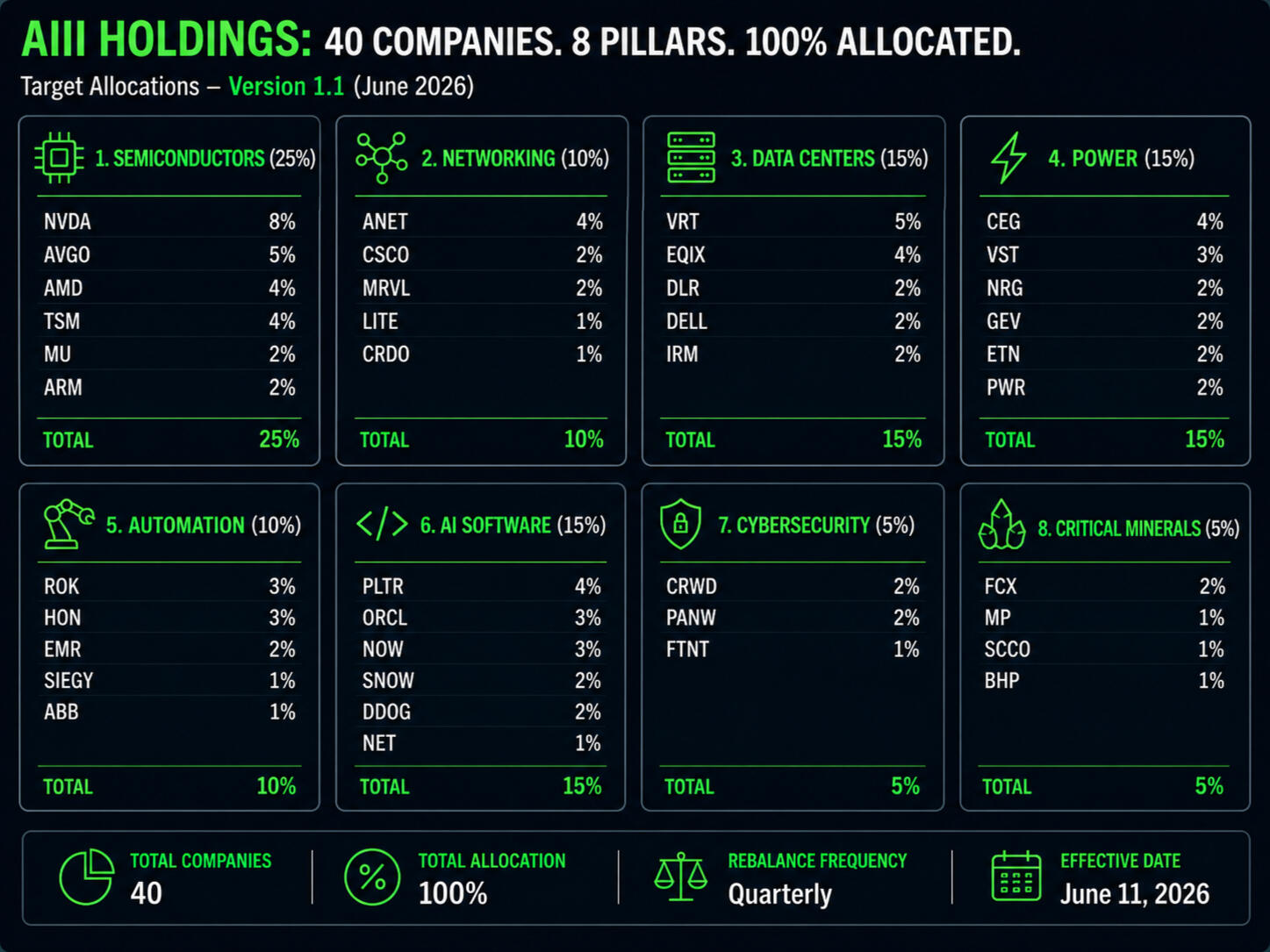
Initial target allocations shown. Actual weights may vary over time based on market performance and index methodology.
Methodology
Index Construction, Maintenance & Oversight
Eligibility CriteriaThe AI Infrastructure Index (AIII) tracks publicly traded companies that provide the foundational technologies, services, and physical infrastructure required to develop, deploy, and scale artificial intelligence.
To be eligible for inclusion, a company must:
• Be listed on a major recognized exchange
• Maintain a minimum market capitalization of $1 billion
• Demonstrate average daily trading value of at least $10 million over the preceding 30 days
• Derive meaningful revenue or strategic activity from one or more of AIII's eight infrastructure pillars
• Demonstrate durable, long-term relevance to the AI infrastructure ecosystemOnce included, a constituent may remain in the index provided it continues to satisfy reduced retention thresholds:
• Minimum market capitalization of $750 million
• Average daily trading value of at least $5 million over the preceding 30 daysWeighting Methodology
AIII uses a strategic weighting approach rather than market-capitalization weighting. Constituent weights are determined based on each company's assessed importance within the AI infrastructure ecosystem, its competitive position within its assigned pillar, and its contribution to overall index diversification.
Target weights are established at each quarterly rebalance and are subject to the following constraints:• No single constituent may exceed 8% of total index weight at the time of rebalancing.
• No single infrastructure pillar may exceed 30% of total index weight.
• Total index weight equals 100%.
Rebalancing ProcessThe index is reviewed quarterly.Scheduled reviews occur at the end of each calendar quarter:March 31
June 30
September 30
December 31During each review, constituent eligibility, pillar allocations, and individual position weights are evaluated to ensure continued alignment with the index methodology.Rebalancing is triggered if:• An individual constituent exceeds 12% of total index weight. (allowed drift threshold)
• An infrastructure pillar exceeds 30% of total index weight.If neither threshold is exceeded, no rebalancing action is required.Extraordinary changes may be made outside of scheduled reviews in the event of mergers, acquisitions, delistings, or other significant corporate actions.Index OversightAIII is maintained in accordance with its published methodology. The Index Administrator conducts a full review at each scheduled rebalance, including constituent eligibility, pillar assignments, and audit scoring. Any material changes to index construction rules, eligibility criteria, or methodology will be publicly disclosed on this website prior to taking effect.
AIII Live Index
AIII has been live since June 12, 2026. Results update every trading day.
 AI Infrastructure Index
AIII vs. Leading Benchmarks
The following backtest compares the AI Infrastructure Index (AIII) against the S&P 500 (SPY) and the Nasdaq-100 (QQQ). Results are based on the current AIII constituent list, target allocations, and published methodology. The analysis reflects threshold-based rebalancing, with quarterly reviews and rebalancing triggered only when diversification thresholds are exceeded.
In this one-year backtest, AIII far outperformed the S&P 500 and Nasdaq-100. While past performance does not guarantee future results, the analysis illustrates the potential benefits of a diversified, infrastructure-focused approach to artificial intelligence investing.
DisclaimerAIII is an independently maintained model index and is not an investment fund, ETF, or investment adviser. The index is provided for informational and educational purposes only and should not be considered investment advice. Past performance does not guarantee future results.
Key Advantages
Why AIII Is Different
Infrastructure-FirstMost AI products will change over time. The infrastructure supporting artificial intelligence will remain essential regardless of which applications ultimately win.
"The largest infrastructure buildout in human history."
— Jensen Huang, CEO, NVIDIAFox Business, January 2026"The market is starting to want to own the bullet makers, not the armies — data centers, industrials, materials, energy — they're all tied to the same thing." CapitalAI Daily
— Tom Lee, Co-Founder, Fundstrat Global AdvisorsCNBC, February 2026
AIII — the AI Infrastructure Index — tracks the 40 companies building the physical and digital foundation of artificial intelligence. One year in, the results speak for themselves.
+94.5% · 1-Year Total Return
3.08 · Sharpe Ratio
+68.8pp · vs. S&P 500